
If you own real estate through a limited liability company (LLC) or corporation, nearly every state requires you to name a registered agent, and who you choose decides whose address ends up on the public record.
Your first rental property might not change much about how you handle paperwork. By the third or fourth — especially across state lines — every lawsuit, tax notice, and state filing reminder needs a reliable place to land, and your home address starts showing up in places you’d rather it didn’t.
Using a professional registered agent in your real estate business is one of the simplest ways to protect your privacy and keep your entities in good standing.
So, do you need a registered agent for real estate? Here’s how the role works, when it’s required, and what to look for in a service.
Key takeaways
- A registered agent receives lawsuits, tax notices, and state correspondence for your real estate LLC or corporation, so you don’t miss a deadline that could cost you good standing.
- Acting as your own registered agent puts your address on the public record, means a process server can deliver a lawsuit to your door, and requires you to be available during business hours.
- If you own property in multiple states, you may need a registered agent in each one… and a professional service can cover them all.
- Stable’s registered agent service works alongside our virtual mailbox, so legal and compliance mail lands in the same dashboard as the rest of your business mail.
What is a registered agent’s role in real estate?
A registered agent is the person or company your business names to receive legal and state correspondence on its behalf. The agent’s name and address are part of your entity’s public record with the state.
There are two primary roles of a registered agent in real estate:
- Service of process: A registered agent accepts lawsuits, subpoenas, and other legal papers on your behalf.
- State compliance: A registered agent receives official state mail, like annual report notices and tax correspondence, and passes it along so you can file on time.
Why does this matter for asset protection? An LLC only shields your personal assets while the entity stays in good standing. If a lawsuit goes unanswered, a court can enter a default judgment against your company. If state notices go unanswered, the state can dissolve the entity. A reliable registered agent helps you avoid both.
Do you need a registered agent for real estate?
Whether you need a registered agent for real estate comes down to one question: Who owns the property — you, or a business entity?
If you hold property in your own name, you don’t need a registered agent. Registered agents exist for business entities, so an individual buying a home or a single rental has nothing to appoint one for, even if the property is in another state.
If you hold property through an LLC or corporation, you need a registered agent in the state where you formed the entity. If the property sits in a different state, you’ll usually need to register the entity there too (a process called foreign qualification) and name a registered agent in that state as well. You can serve as your own agent in a state where you have a physical address, but a registered agent service keeps your home address off the public record.
For most investors, the real decision isn’t whether to have a registered agent. It’s whether to be your own.
The risks of being your own registered agent as a landlord
Being your own registered agent is free, but the trade-offs grow with your portfolio.
Your home address on the public record
Privacy is one of the biggest benefits of using a registered agent in the real estate business. The best registered agent services for real estate investors give you a physical street address in the state to list on state filings, so your personal address stays off the public record.
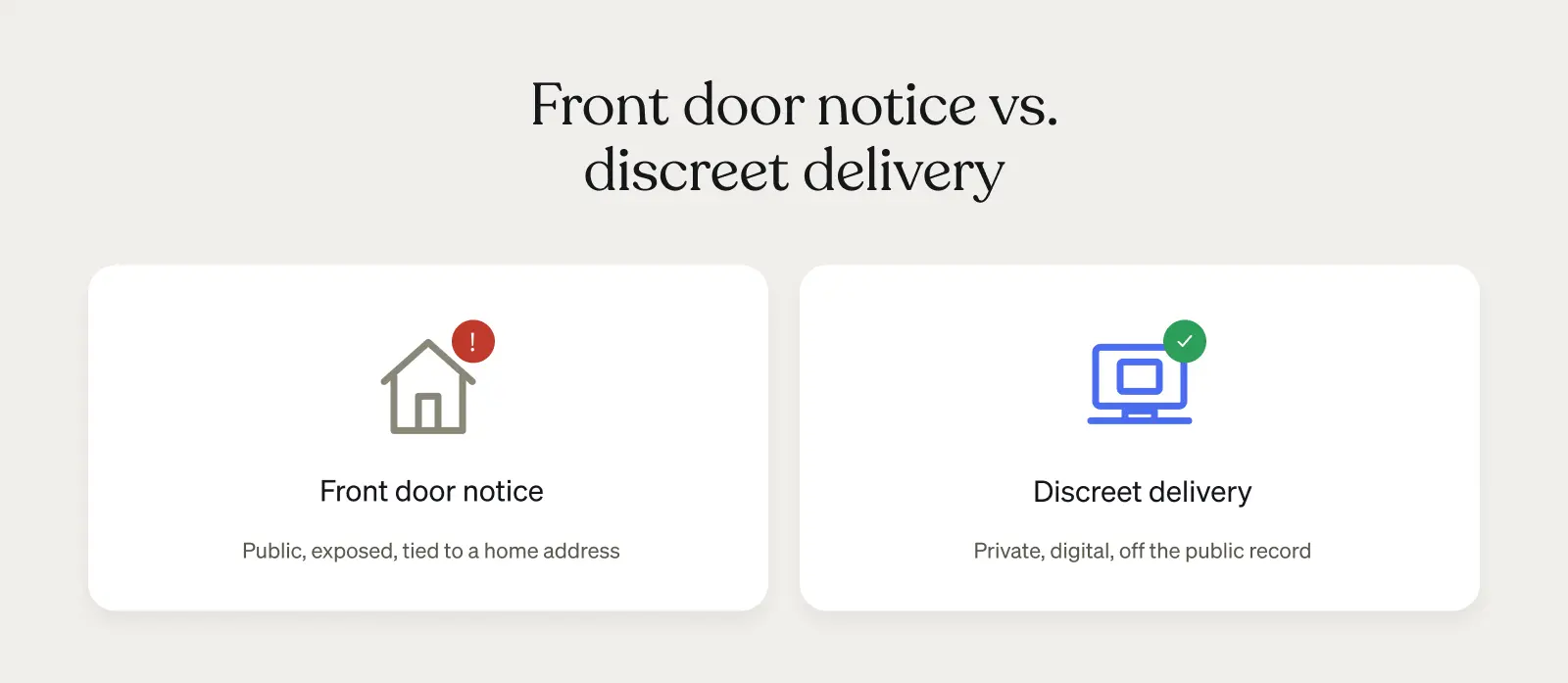
When you act as your own registered agent, you list your own street address, and anyone can look it up in the state’s business entity search. For landlords, that means tenants, contractors, and anyone else can find where you live.
Keep in mind that your registered agent address is only for legal and state mail. To keep your home address off vendor invoices, bank statements, and other business correspondence, pair it with a virtual business address.
Being served in front of tenants
Process servers deliver lawsuits and subpoenas to your registered agent’s address. If that’s your home or office, a process server can show up in front of your family, your employees, or your tenants.
With a registered agent service like Stable, the agent receives the papers and we upload a scan to your secure dashboard — or ship you the original on request — so a lawsuit never becomes a scene.
Staying available while you’re at your properties
Most states require a registered agent to be available at the listed address during normal business hours to accept legal papers. If you’re your own agent, that means staying put from 9 a.m. to 5 p.m. — tough to pull off when you’re touring properties, meeting contractors, or traveling.
A registered agent service keeps someone at that address every business day, so a time-sensitive notice doesn’t sit unclaimed.
Why professional registered agents are standard for real estate investors
New investors with a single in-state property often act as their own registered agent. As a portfolio grows, a professional service becomes the norm for three reasons.
- Privacy: A professional registered agent keeps your home address off your state filings. Full anonymity depends on the state. Some, like Delaware and Wyoming, don’t require member or manager names on formation filings.
- Multi-state flexibility: One service can act as your registered agent in every state where your entities are registered. You can only be your own agent in a state where you have a physical address, so out-of-state properties require someone else anyway.
- Digital access: With Stable, we upload registered agent documents to your dashboard in as little as one day, right alongside the rest of your business mail, and every document is searchable.
DIY vs. professional registered agents for rental property LLCs
How Stable protects your real estate portfolio
Stable makes registered agent service one less thing to manage. We act as your registered agent in all 50 states, plus Washington, D.C., and Puerto Rico, and upload legal and state documents to your dashboard in as little as one day. Your registered agent mail sits alongside your everyday business mail, so every notice for every property lives in one place.
Expanding into a new state? You can file a foreign qualification or change of agent right from your dashboard. We also check your entity’s record with the state every month and alert you when something changes, so you can act before it affects your good standing.
Add a registered agent to your Stable account and keep your home address off the public record.
FAQs
Is a registered agent required for a property holding company?
Yes, if the holding company is an LLC, corporation, or other registered entity. It needs a registered agent in the state where it was formed and in any state where it’s registered to do business. If you hold property in your own name, you don’t need one.
Can I use a property manager as my registered agent?
Yes, as long as your property manager agrees and meets the state’s requirements, like a physical street address in the state and availability during business hours. The catch: If you switch property managers, you’ll need to file a change of registered agent with the state, and a lawsuit that arrives during the transition could go unanswered. A dedicated registered agent service avoids that gap. Running a property management company yourself? Here’s why property management LLCs need a high-reliability registered agent.
Is a registered agent required in New York for real estate?
No. New York doesn’t require LLCs or corporations to name a registered agent. Instead, the Department of State acts as your agent for service of process and mails any legal papers it receives to the address you keep on file, which is public. Many New York investors use a registered agent service’s address for that purpose, which keeps their own address private and gets legal papers handled promptly. New York LLCs also have to meet a publication requirement within 120 days of forming. Our guide to forming an LLC in New York walks through it.
Can I act as my own registered agent for my out-of-state rental property?
Usually not. To be a registered agent, you need a physical street address in that state, and many states require an individual agent to live there. If your LLC is registered in the state where the rental sits, you’ll need an agent there, either a registered agent service or a friend or family member who lives in the state.
Does Stable monitor my standing with the state?
Yes. Every Stable registered agent includes entity monitoring. We check your entity’s record with the state each month and alert you when something changes, like your status or registered agent details, so you can act before it affects your good standing.