Research Report

How do businesses manage mail and what is it really costing them?

February 20, 2026 — Andrea Salerno

Mail. Businesses have been dealing with it for… well, forever. If you have spent your career working around it — office mailrooms, certified letters, check runs, “did anyone see the invoice?” — it can feel normal. Like background noise. Just one more admin task that comes with running a business. But everything else has moved on.

Communication is digital. Workflows are digital. Systems are digital. Even so-called “paper processes” usually live as PDFs in a shared drive. And yet a surprising amount of business still depends on literal envelopes: incorporation documents, tax notices, regulatory mail, legal correspondence, customer communications, invoices, checks, and vendor notices. In many cases, this is not a preference. It is a requirement.

That tension (between how modern businesses operate and how mail management for business still works) is at the heart of modern mail management, and it is what prompted this research.

To understand how businesses manage mail today — and what it is really costing them, including the hidden cost of manual mail management — we surveyed more than 250 US-based professionals who are directly responsible for managing business mail.

Key takeaways
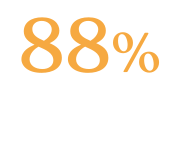
  • Manual and hybrid mail workflows quietly drain time from higher-value work, with 88% of respondents saying mail interrupts their most important responsibilities.

  • Mail-based workflows leave businesses exposed to real risk, including missed deadlines, delayed payments, compliance issues, and operational disruption.

  • The cost of mail is rarely visible, but it compounds through repetitive tasks like sorting, scanning, routing, forwarding, and depositing checks.

  • Mid-size and enterprise businesses feel the impact most, with higher mail volumes, more handoffs, and greater compliance exposure.

  • Modernizing mail management through digitization, automation, and AI can turn mail from a constant interruption into a background process that simply works.

Mail is one of the last analog workflows inside modern operations, and it is quietly taxing your time, focus, and risk profile.

Mail is the rare operational process where 99% can be junk, and the other 1% can seriously hurt you if you miss it. The consequences are not theoretical. Missed mail can mean compliance exposure, business continuity issues, delayed cash flow, missed deadlines, and frustrated customers or partners. Mail cannot be ignored, but it also cannot keep operating the way it always has.

Even when nothing goes wrong, mail quietly taxes your organization. Someone sorts it. Someone scans it. Someone routes it. Someone deposits checks. Someone tracks down what went missing. Whether that “someone” is a dedicated role with a full salary or a rotating cast of employees with other full-time jobs, the outcome is the same: time and attention leak away from higher-value work.

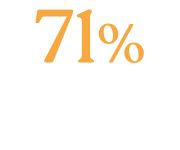
The data makes that trade-off impossible to ignore. In our survey, 88% of respondents say mail interrupts higher-value work, rising to 96% for mid-size and enterprise businesses. It is no surprise, then, that 71% of respondents say mail-based workflows are disruptive to their overall operations, a number that jumps to 85% for mid-size and enterprise businesses.

Mail is one of the last analog workflows inside modern operations, and it is quietly taxing your time, focus, and risk profile. This report examines what mail is really costing businesses today and what changes when organizations invest in modern mail management.

01

The true time cost of manual mail management

For mail-heavy businesses, the cost of mail management is directly connected to time. Time means money, but it also means something harder to measure: the work your team does not get to do because they are stuck sorting envelopes, scanning documents, and chasing missing items.

Over time, that kind of tedious work also increases burnout risk and erodes morale, especially when employees know the task should be automated.

This is how mail management for businesses quietly becomes an operational bottleneck as organizations scale.

Manual processes are still the norm

Even now, many teams are managing mail the hard way— through manual mail management — not because they choose to, but because mail sits awkwardly between physical and digital work. In our research, 31% of respondents say they manage mail completely manually, relying on physical sorting, in-person pickup, and informal handoffs. An additional 44% say their process is a mixture of manual and digital, often involving scanning documents, uploading files, and then routing information by hand across teams and systems.

What looks like digitization is often just operational inefficiency disguised as progress.

On the surface, this hybrid approach can feel like progress. There is less paper moving around the office, and more mail ends up online. But in reality, manual effort does not disappear — it multiplies. Responsibility gets spread across people and tools, and the process becomes harder to manage, harder to scale, and easier to break as teams grow or become more distributed. What looks like digitization is often just operational inefficiency disguised as progress.

Tedious, time-consuming administrative tasks drain teams

For many organizations, the true cost of mail management doesn’t show up as a single problem, but in the steady accumulation of small, time-consuming administrative tasks: sorting envelopes, scanning documents, tracking deliveries, forwarding mail, depositing checks. Each task on its own feels manageable. Together they create operational inefficiency that steals hours every week and pulls teams away from more impactful work.

This time loss becomes especially visible at scale. Thirty-three percent of mid-size and enterprise businesses spend more than 10 hours per week managing mail, turning what should be a background process into a recurring operational tax. And this low level work can drain both time and morale.

The most tedious mail management tasks

According to our research, the following tasks are the most tedious for mail managers:

Most tedious tasks involved in managing business mail

Percentage breakdown of tedious mail management tasks
Task Percentage
Sorting mail 49%
Scanning and uploading documents 34%
Tracking and logging incoming mail 29%
Depositing checks 27%
Forwarding mail to other people 25%
Searching for lost or misplaced items 24%
Traveling to retrieve mail 21%
Integrating mail with other systems 20%
Source: Stable business mail management survey of U.S. business professionals who manage company mail, 2025.

When looking specifically at mid-size and enterprise businesses, where mail volume and complexity are higher, the burden intensifies around getting mail to the right place. While sorting and scanning are still the biggest drains, forwarding mail becomes a major source of friction, with 48% of respondents reporting it as a time suck. 

Manual and hybrid mail workflows siphon away time every week, especially as companies grow. And because this work is repetitive, predictable, and rules-based, it is also highly automatable, transforming mail from a constant interruption into a background process that simply works.


02

When mail interrupts the work that actually drives growth

Mail management may just be thought of as tedious, but unfortunately it can directly impact a business’ bottom line. This is where mail moves from “annoying” to “expensive.” When routine, time consuming administrative tasks repeatedly interrupt focus, the cost is no longer measured only in hours. It is measured in opportunity cost: what those hours could have produced if they were spent elsewhere.

As previously stated, 88% of respondents said mail-related tasks interrupt higher-value work. For mid-size and enterprise businesses, who often have to deal with a higher volume of mail and more complex workflows, that number rises to 96%. Mail is not just taking time. It is stealing the time you would otherwise spend improving the business.

When routine administrative tasks repeatedly interrupt focus, the cost is no longer measured only in hours, but in what those hours could have produced if spent elsewhere.

What mail pulls teams away from

When mail interrupts work, it does not interrupt it evenly. The time lost to mail management is time taken away from specific functions that are critical to efficiency, growth, and customer experience.

Top functions mail management takes time away from:
  • Operations and process improvement

  • Customer service

  • Business development / growth

  • Supporting and managing the workplace

  • Financial and strategic work

  • Team management

Source: Stable business mail management survey of U.S. business professionals who manage company mail, 2025.

Why these tradeoffs matter

The impact of those trade-offs shows up directly in business performance. For instance, customer experience is strongly correlated with revenue growth. McKinsey has reported that customer experience “leaders”, meaning businesses that focus on and excel in the customer experience, achieve more than double the revenue growth of “laggards”.

At the same time, when teams lose time to manual mail workflows, they have less capacity to improve how operations actually run. Small inefficiencies turn into persistent operational bottlenecks, slowing execution and making organizations less resilient as they scale. 

Research from Deloitte shows that companies who focus on digitally transforming operations are two to three times more likely to outperform their peers both on revenue growth and profit margins.

When time is absorbed by repetitive, time-consuming administrative work, it is time not spent improving how the business actually runs.

The hidden cost: opportunity cost

The most obvious cost of manual mail management is labor: the hours teams spend sorting, scanning, routing, and tracking mail each week. But the larger cost is often invisible. It is the opportunity cost: everything those hours could have produced if they were spent elsewhere. When time is absorbed by repetitive, time-consuming administrative work, it is time not spent improving how the business actually runs.

This opportunity cost creates operational bottlenecks across the organization:

  • Finance teams have less time to close the books faster and resolve issues before they escalate

  • Internal processes remain fragile instead of becoming systems that scale cleanly

  • Workplace operations shift from proactive to reactive, focused on keeping things moving rather than improving how work gets done

Over time, these compounding trade-offs limit efficiency, slow growth, and reduce the overall quality of day-to-day operations.

03

The risk multipliers: lost mail, missed deadlines, and compliance exposure

Time is one issue, but risk is another. And mail is uniquely risky because it is physical, location-dependent, and often invisible until it is too late. For many small businesses, using a home address to incorporate — especially if you plan to operate remotely, or before you have established a physical presence — is a simple and understandable choice. But as companies grow, that decision introduces real mail compliance risk.

In fact, 32% of businesses surveyed still list a home address as their permanent business address, creating privacy concerns, confusion between personal and business mail, and operational fragility. When teams move, expand, or begin managing mail across multiple locations, the address changes — and suddenly the entire mail “system” changes with it. This increases the likelihood of lost business mail, delayed delivery, and compliance exposure at exactly the wrong time.

For respondents who move locations or manage mail across multiple locations, the following issues were reported:

Mail-related risk
% of respondents affected
Delay in receiving important documents
23%
Mail sent to outdated or incorrect address
22%
Loss of mail during a move
16%
Confusion about where mail should be sent
15%
Customer or vendor frustration
15%
Time lost managing mail across locations
12%
Compliance or legal issues due to address changes
7%
Source: Stable business mail management survey of U.S. business professionals who manage company mail, 2025.

As mail becomes more distributed, risk compounds. Not because teams are careless, but because manual, location-based systems do not scale cleanly.

Case Study

Mail confusion becomes operational chaos

AutoCamp, a hospitality company that offers the comforts of a high-end hotel in some of America’s most beautiful nature escapes, experienced significant operational risk due to mail issues. Their liquor license listed both a corporate address and a physical location address, but the state mailed the license to the wrong one. After trying and failing to track it down, AutoCamp had to go through the long process of getting a new copy issued.

The downstream impact was immediate: vendors could not sell them alcohol without the license onsite at the front desk. What began as misplaced mail quickly became a business-critical disruption. This was just one of many reasons the business decided to switch to Stable for address and mail management.

Mail failures don’t just slow work. They create real business risk.

Lost or delayed mail creates real business consequences

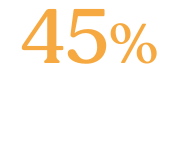
Lost or delayed mail is not hypothetical. It is a common outcome of systems that rely on physical locations, manual handoffs, and human memory. In fact, 45% of respondents say they have missed deadlines due to mail issues, including missed payments or important notices, with 21% saying it has happened more than once. Another 28% say it has not yet happened, but is a major concern, underscoring how widespread mail compliance risk feels,  even among teams that have not yet experienced a failure.

To better understand the impact of lost business mail, respondents were asked to identify the consequences they have personally experienced.

Top consequences of lost/delayed mail

Consequence Percentage
Lost/misplaced documents 46%
Delayed payments 41%
Customer/vendor frustration 33%
Internal workflow delays 22%
Compliance/legal risk 13%
Team burnout 12%
Source: Stable business mail management survey of U.S. business professionals who manage company mail, 2025.

What begins as a missing envelope or delayed document often turns into something much larger. Mail failures don’t just slow work. They create real business risk.

04

The shift toward digitization, automated mail management, and AI

Mail has to exist, but it does not have to be stuck in the past. As pressure builds to operate faster, more efficiently, and with fewer manual handoffs, teams are increasingly looking to digitize the processes that still slow them down. Mail management is emerging as a prime candidate for automation. That shift is already underway. In the survey, 80% of respondents say it is a priority to digitize their operational processes over the next 12 months, rising to 90% for mid-size and enterprise businesses.

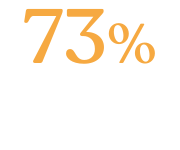
Automation is also no longer seen as optional or experimental. Seventy-three percent of respondents say they are interested in using AI and automation to handle mail management, with interest climbing to 81% among mid-size and enterprise businesses. This reflects a broader change in expectations: teams want automated mail management systems that reduce manual work, improve visibility, and scale without adding complexity.

That mindset extends well beyond mail. Gartner has reported that 80% of executives believe automation can be applied to any business decision, highlighting just how normalized automation — and AI-powered workflow design — has become as a way to remove friction and improve outcomes across operations.

Together, these trends point to a clear inflection point: businesses are no longer asking if workflows should be digitized and automated, but which workflows still create unnecessary friction. Mail stands out as one of the last remaining analog workflows (and one of the most impactful to modernize through a digital mailroom solution).

What teams actually want automated

When asked what would make the biggest difference in mail management, respondents consistently pointed to features that eliminate manual steps and integrate directly into existing workflows — the core promise of AI mail processing and modern mail platforms.

Top tasks mail managers would like to be automated:
  • Automated scanning and digitization of mail

  • AI summaries of mail

  • Searchable digital archives

  • Automated check deposit

  • Integration of mail into existing systems

  • Automated routing / forwarding of mail to right team member

  • Notifications and audit trail

Source: Stable business mail management survey of U.S. business professionals who manage company mail, 2025.

Taken together, the data shows that teams are looking to AI mail processing to remove tedium. The most valued features are the ones that eliminate repetitive work, improve visibility, and ensure mail reaches the right person without manual intervention.

Case Study

Mail made machine-readable

As a tech-enabled healthcare company scaled, manual mail processing quickly became unmanageable, creating 10–14 day backlogs and consuming nearly a full-time role. By digitizing mail and making it machine-readable through Stable’s virtual mailbox, the Workplace Manager was able to automate sorting and routing across complex workflows, cutting mail processing time by over 90% and reducing turnaround to within 24 hours.

What once took forty hours a week now takes just two — freeing the team to move faster, stay compliant, and focus on higher-impact work. The team describes the combination of instant access, automated mail management, and AI-driven workflows as nitro for their operations.

05

Barriers to change (and how modern teams address them)

Even with strong intent to modernize operations, buyers often have legitimate concerns about changing long-standing mail management processes. Mail touches sensitive information, financial workflows, and compliance-critical documents, making the perceived risk of change feel high.

For instance, 38% of respondents are concerned about security and privacy when evaluating new operational tools, and 22% are concerned about the complexity of integrating new solutions into their existing systems.

These objections are reasonable. Not all mail management solutions are built to support secure, scalable operations. The difference between tools that simply digitize mail and those that enable modern, automated mail management often comes down to how well they address security, visibility, and integration from day one.

What modern mail management solutions need to provide

To overcome these barriers, teams look for solutions that reduce risk — not introduce new ones. Effective modern mail management platforms share a common set of capabilities that support security, compliance, and operational continuity.

Capability
Why it matters
Secure, controlled access 
(SOC 2 and HIPAA compliance)
Protects sensitive mail and reduces compliance risk
Digital audit trails
Creates visibility into what was received, accessed, and actioned — and when
Flexible workflow integration
Allows mail to fit into existing systems instead of creating new silos
Centralized visibility across locations
Supports teams managing mail across multiple offices or remote locations
Source: Stable business mail management survey of U.S. business professionals who manage company mail, 2025.

By addressing these requirements directly, modern mail management solutions remove friction from the transition itself. Instead of forcing teams to choose between speed and security, the right platform enables both, making it easier to automate mail workflows without sacrificing control or compliance.

06

The business case for modern mail management

In a world moving at the pace of AI, time is precious and operational errors can be costly. When teams modernize, digitize, and integrate mail into existing workflows, they remove friction in one of the last analog systems inside modern operations.

The data shows a clear business case. When asked why they want to move away from manual and hybrid processes, respondents consistently point to outcomes tied directly to efficiency and risk reduction.

Why businesses want to switch to a digital mail solution
  • Saving time

  • Reducing errors

  • Improving operational efficiency

Source: Stable business mail management survey of U.S. business professionals who manage company mail, 2025.

When mail management is modernized:

  • Daily interruptions decrease, allowing teams to stay focused on higher-value work

  • Decisions happen faster, with fewer handoffs and less manual coordination

  • Risk is reduced, as mail becomes more visible, trackable, and auditable

  • Operational efficiency improves, freeing time for strategic initiatives instead of reactive tasks

Mail cannot be eliminated, but when it is modernized through digital mail solutions, it shifts from a constant distraction into a background process that supports the business instead of slowing it down.

Remove the friction where it still hides

Mail is one of the last non-digital operational systems still embedded in modern businesses, and its cost goes far beyond paper. Manual mail processes drain time, fragment focus, and introduce unnecessary risk — all of which slow growth.

Organizations that modernize mail management by digitizing and automating mail workflows, reclaim hours every week, reduce costly mistakes, and enable their teams to focus on the work that truly matters. When mail becomes part of a digital mail solution for businesses, it shifts from an operational liability into a dependable background system.

In modern operations, efficiency is not about working harder. It is about removing friction wherever it hides.
When mail management is modernized:
  • Daily interruptions decrease, allowing teams to stay focused on higher-value work

  • Decisions happen faster, with fewer handoffs and less manual coordination

  • Risk is reduced, as mail becomes more visible, trackable, and auditable

  • Operational efficiency improves, freeing time for strategic initiatives instead of reactive tasks

How modern teams are already seeing results

Darwin Homes

By eliminating manual coordination across teams, Stable reduced the time Darwin Homes spent managing mail by 90%, turning what was once a costly, time-consuming process into a streamlined and more affordable operation.

Aiven

After years of mail arriving late and putting the company at risk for fees and non-compliance, Stable enabled Aiven to open and act on mail within days instead of weeks, automating routing and saving hours each week that were previously spent managing delays.

Farmers Business Network

By making everyday operations more efficient, Stable helps Farmers Business Network free up time and resources that ultimately allow them to focus more on supporting independent, family farmers.

In modern operations, efficiency is not about working harder. It is about removing friction wherever it hides.

If mail is interrupting higher-value work, creating risk, or slowing down your workflows, Stable can help you modernize mail management and automate mail workflows with a digital mail solution built for growing businesses. 

Talk to our team about modernizing mail management so your organization can move forward faster.

Survey methodology

The results presented in this report are from a survey conducted online within the United States by Researchscape on behalf of Stable between December 5th and December 24th, 2025. A total of 268 responses were recorded, of adults 18+ who reside within the United States. All respondents were involved in the management of mail for their organization. Small businesses are quantified as businesses with less than 100 employees, mid-size businesses are between 100 and 500 employees, and enterprise businesses have more than 500 employees. Stable developed the survey in conjunction with Researchscape and data was scrubbed during the course of the research to ensure accurate responses. No personal information was gathered from respondents during the course of the survey.

Share this post