
State-Compliant Registered Agent Services
Do business anywhere. We’ll handle the paperwork.
Stable helps businesses stay compliant with a nationwide registered agent service that centralizes mail management and automates filings.

Trusted by 15,000+ businesses







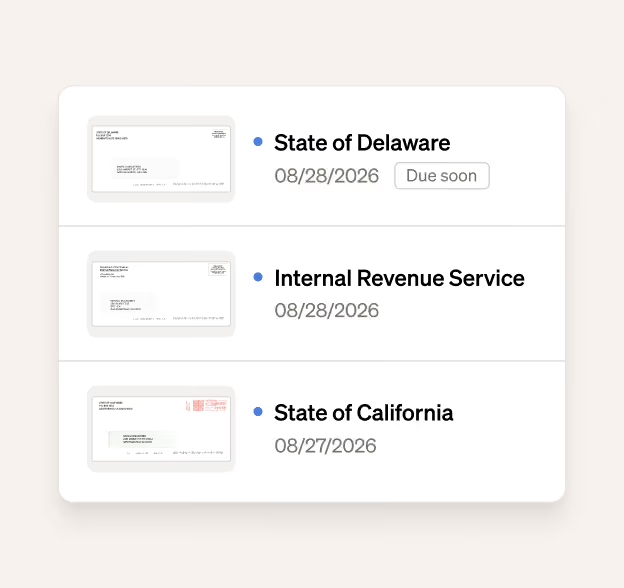
Never miss critical notices
Stable gives you instant digital access to state and legal mail along with the automated routing and collaboration tools to act on it quickly.
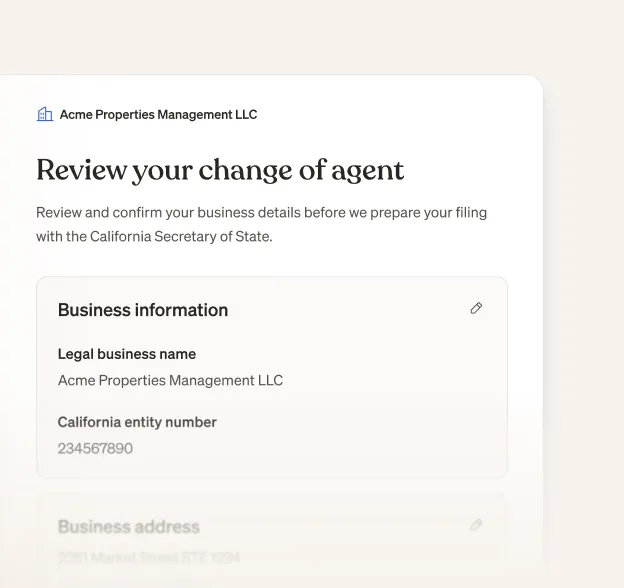
Stay ahead of the curve
Stable provides automated filing guidance, prefilled forms, and deadline notifications, saving hours of manual work.
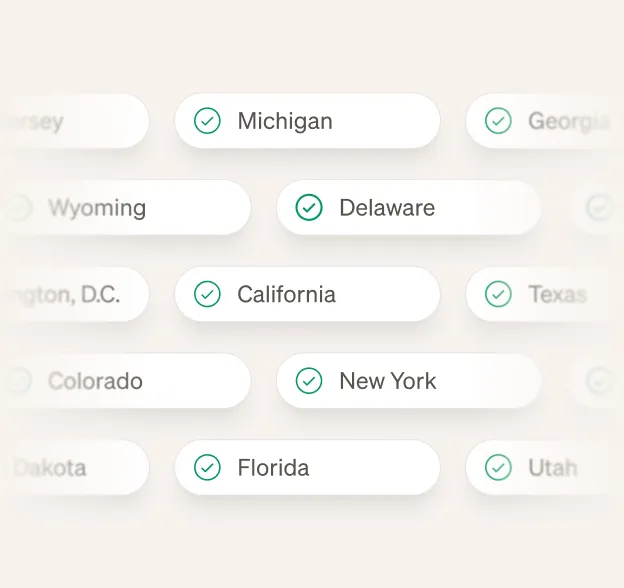
Scale without complexity
Stable offers registered agent coverage in all 50 states and makes it simple to manage filings across jurisdictions and entities.
A registered agent service that grows with your business



Let Stable handle the filings
We don’t just give you a registered agent address — we guide you through the filings required to stay in good standing with the state.
Avoid missed deadlines with automatic filing deadline notifications.
Save time by filing directly in Stable with guided workflows and pre-filled forms.
See state and legal mail the moment it arrives, alongside your business mail.
Change of agent
Change your registered agent to Stable seamlessly.
Foreign qualification
Expand operations into new states compliantly.
Additional filings
Ensure state compliance with filing support for annual reports, amendments, EIN, and more.
Protect your good standing
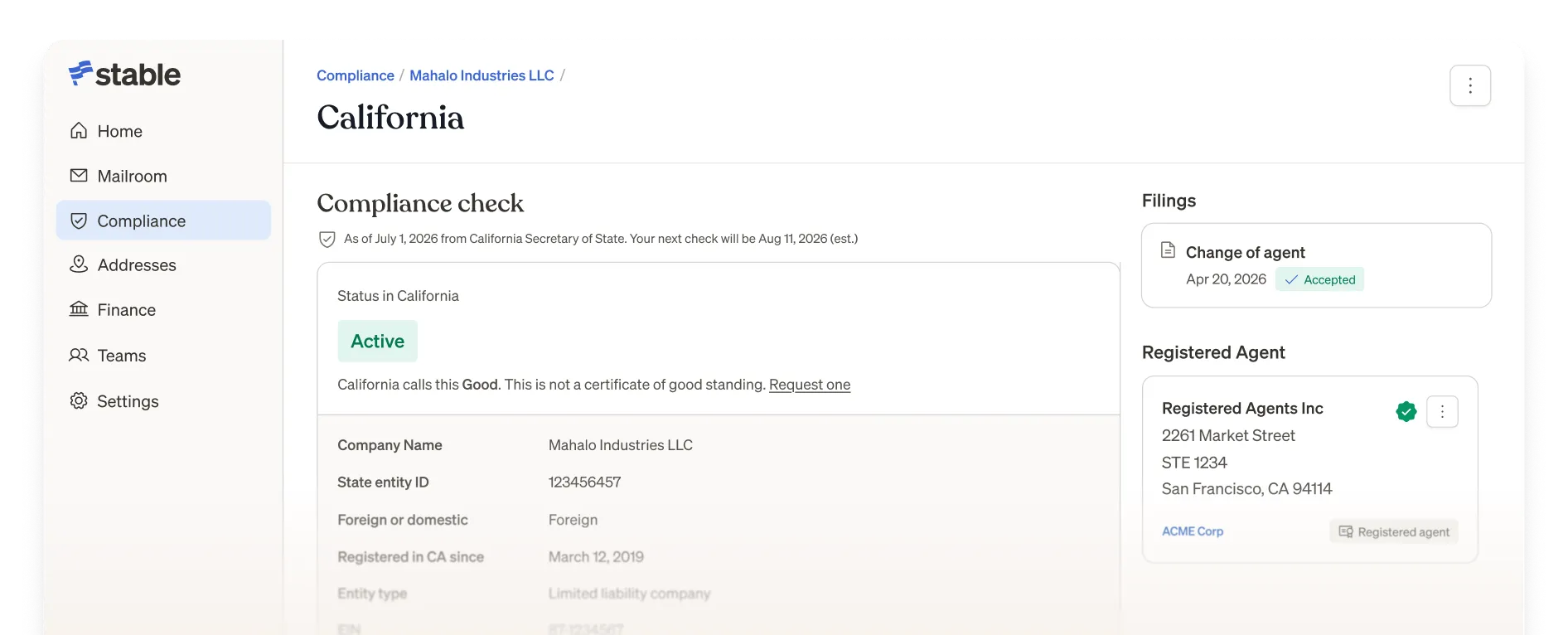
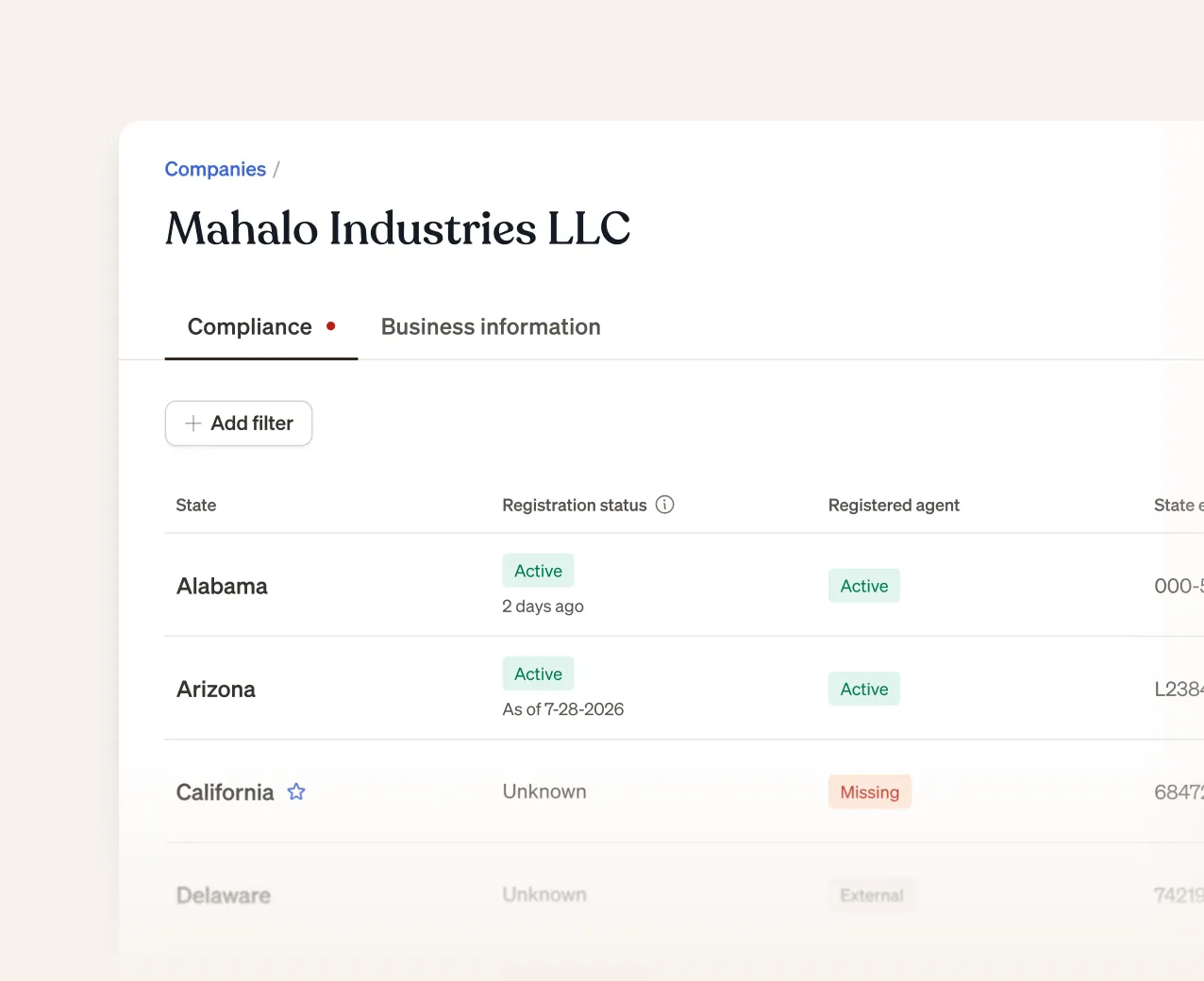
Stable continuously monitors state records for changes to your business information and standing, so you can catch issues before they become bigger problems.
Verify that your Stable registered agent is correctly on file with the state.
Stay ahead of compliance issues by catching unauthorized changes to your registered agent or business information.
Build a monthly history of your standing to share with investors, lenders, and partners.
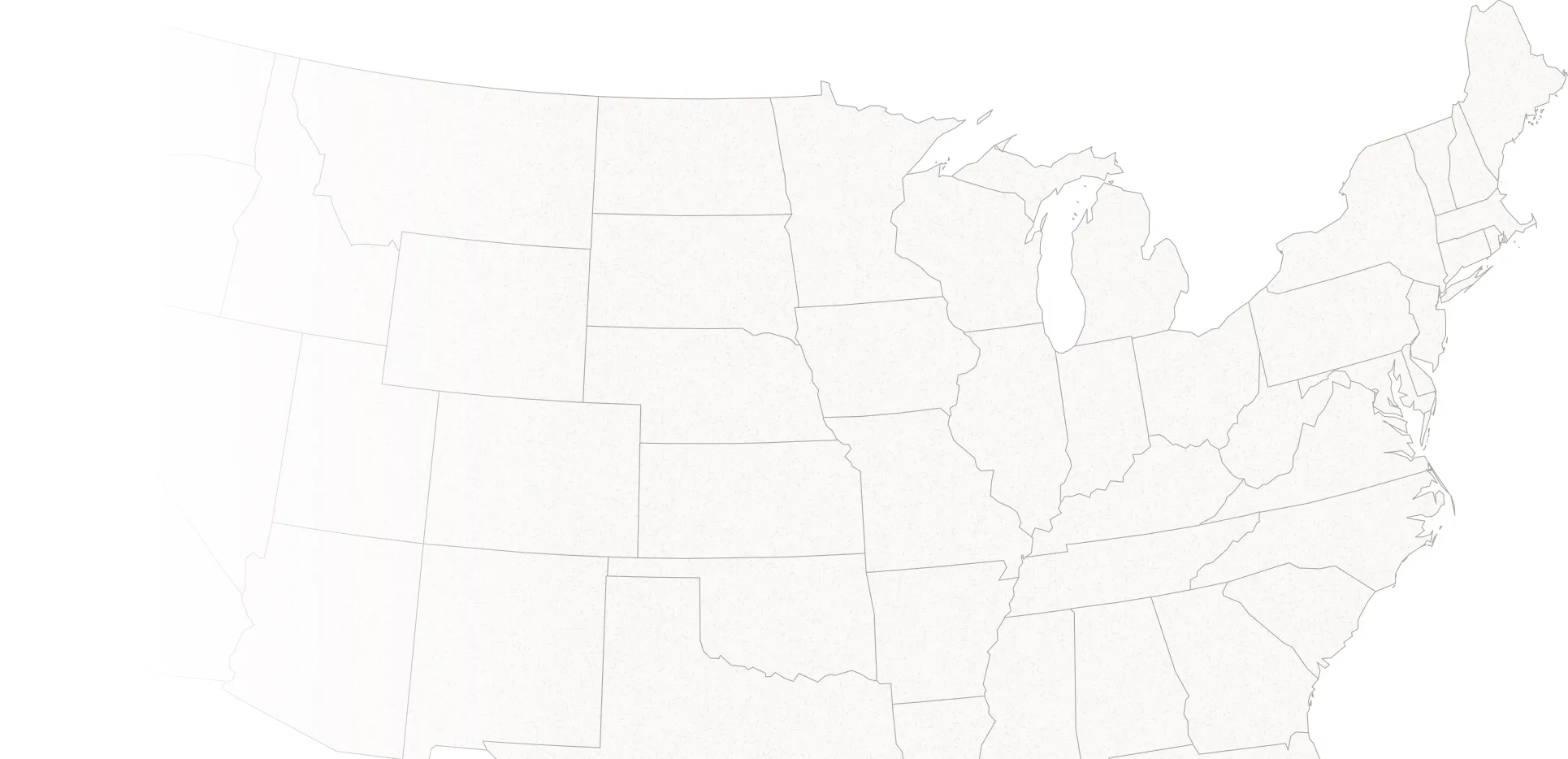
Get coverage in all 50 states
Whether you're a single-state LLC or a multi-state entity with foreign qualifications across the country, Stable can be your registered agent anywhere in the United States, including Washington, D.C. and Puerto Rico.
Turn registered agents into a revenue stream
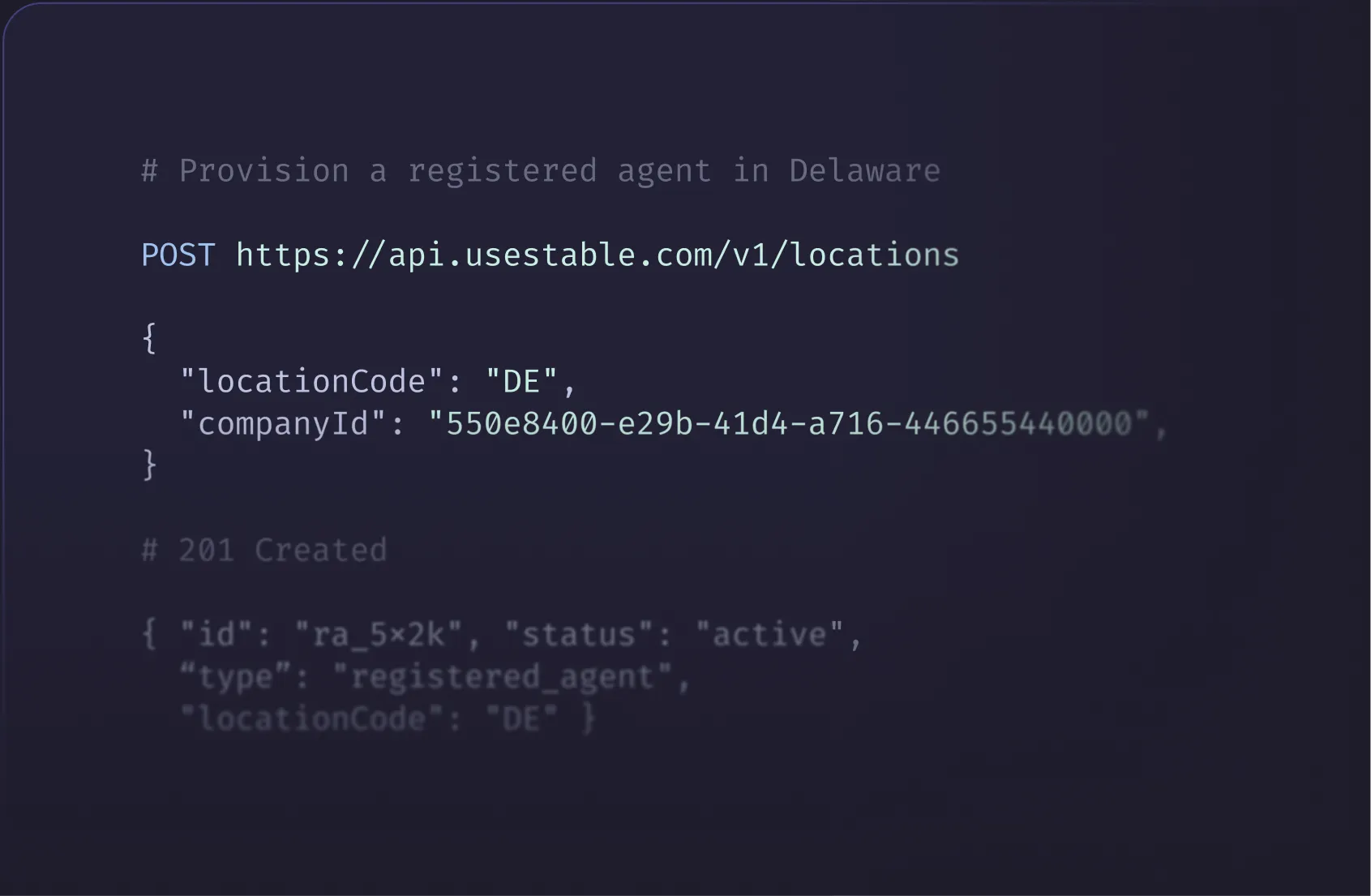
Offer registered agent services to your customers by using Stable’s API. Your customers will get a simple way to manage their registered agents and filings from inside your platform.
Provision registered agents for any entity, in any state, on demand.
Trigger and manage change of agent and foreign qualification filings programmatically.
Monitor mail and compliance status across every entity from a single source.

Get a registered agent with Stable today
Bring your legal and state mail together with your business mail by adding a registered agent to any Stable package.
Using Stable vs. serving as your own registered agent
Mail-related risk
Stable registered agent
Serving as your own registered agent




Frequently asked questions
Don't see your question answered? Email us instead.
What is a registered agent?
A registered agent is a person or service that is officially designated to receive legal and government documents on behalf of a business. Business entities are legally required to have a registered agent in the state where they’re formed and in any state where they’re operating. You can choose to serve as your own registered agent, choose a trusted partner/colleague to be your registered agent, or use a third-party service like Stable. Whichever route you choose, your registered agent must have a physical street address (no P.O. boxes) in the state of registration and be available at that address during normal business hours to receive any state or legal mail that should need to be delivered.
Is a registered agent address the same as a business address?
Not necessarily. Your registered agent address is for accepting state and legal mail, while your business address is what you use for operations. A business address and a registered agent address can be the same if the business chooses to take on the responsibility of serving as its own registered agent. But it requires that: a) it be specifically designated as such b) someone has to be at that address during business hours to receive any state or legal mail that should arrive. In the case of a virtual address, this requirement cannot be met.
How can companies find out if they’re in ‘good standing’?
To be in “good standing” means the state considers your entity active and compliant with its ongoing legal requirements (taxes/fees are paid, annual filings are submitted, licenses & permits are accounted for, etc). The easiest way to find out if your business is in good standing is to check your state’s Secretary of State website (some states charge for this). You can use your legal entity name or Entity ID number to search for your business. There you will see the compliance status of your business.
What’s at risk if you’re not in good standing?
Common reasons for falling out of good standing include things like missing an annual report deadline, not paying franchise taxes, registered agent resigns and not replaced, incorrect address for official notices, ignoring compliance notices. Should you fall out of good standing, it can put you at risk: your ability to enforce contracts, your access to courts, your credibility, and more. Most issues are fixable — but the cost and complexity grow over time.
Is a registered agent really required in every state?
All 50 states require registered agents for LLCs/corporations operating in their state. There are minor exceptions or unique circumstances, such as certain types of non-profits or slight variations in how it's implemented. But for practical purposes, if you're forming an LLC or corporation anywhere in the United States, you need a registered agent.
Can you define what it means to be ‘operating’ in a state?
In the context of registered agent requirements, a business is considered to be “operating” in a state if it has a physical or legal presence there. You are considered to be operating in a state if any of the following are true:
- Physical presence: Maintaining an office, warehouse, retail location, or other facility.
- Employees: Having employees working in the state on a regular basis.
- Property ownership: Owning or leasing real property for business purposes.
- Bank accounts: Maintaining business bank accounts with in-state financial institutions.
- Licenses and permits: Obtaining state-specific professional licenses or business permits.
How does your incorporation status impact where you need a registered agent?
There are two scenarios:
- State of Incorporation: When a business incorporates or forms an LLC in a state, it must designate a registered agent in that state as part of the formation process regardless of where the business actually operates. For example, A Delaware C-Corp that operates entirely in California with no Delaware offices, employees, or customers still must maintain a registered agent in Delaware because that's where it's incorporated.
- Foreign Registration: When a business incorporated in one state conducts business in another state, it must "qualify" or "register as a foreign entity" in that other state and designate a registered agent there. For example: That same Delaware C-Corp operating in California must also register as a "foreign corporation" in California and designate a designate a California registered agent.
Why use an RA service instead of doing it yourself?
You can serve as your own registered agent and many businesses do. The reason for a business to choose Stable as their RA is that we already receive and digitize all their business mail. By adding our RA service, we can handle their state and legal mail, too. You’ll consolidate vendors while gaining faster access to compliance and regulatory mail. On top of that: there are many reasons to choose a service like Stable’s over doing it yourself, such as avoiding the administrative burden, not reliably being at your filed address during business hours, and wanting to maintain privacy.
What does Stable’s RA service do?
Stable has a registered agent address in all fifty states (plus DC and Puerto Rico). The registered agent at each of those addresses will be available during business hours to receive official state and legal mail. Scenarios under which state and legal mail might be received include:
- Ensure you have a point of contact for state governments: If you’re out of compliance with state law or have filed state taxes incorrectly, the state will contact your registered agent.
- Make sure your state filing is up to date: If there’s additional action needed to keep your company in good standing, the state will send paperwork to your registered agent.
- Stay notified about any lawsuits + legal matters: If people have legal matters with your company, they will reach out at this address.
Stable’s registered agent will contact you via email about any state and legal mail received. Additionally, we will upload any mail received at your registered agent address to the Stable platform (in as little as one day) so that you can manage it alongside your business mail.
What’s the difference between a change of agent filing and a foreign qualification filing?
Both filings are how you get your Stable registered agent officially on file with a state — but which one you need depends on whether your business is already registered there.
- Change of agent filing: Used when your business is already registered in a state and you're switching to a new registered agent. This notifies the Secretary of State that your registered agent address has changed. It does not register your business in a new state. State filing fees typically range from $25 to $150 per state.
- Foreign qualification: Used when your business is not yet registered in a state but needs to operate there (and therefore needs a registered agent there). Your business is considered "domestic" only in its formation state — in every other state, it's considered "foreign," hence the term. A foreign qualification registers your business to operate in that state and designates your registered agent at the same time. Average state fees are approximately $230 for corporations and $190 for LLCs, though costs vary significantly by state.
In short: if you're operating in a new state, you need a foreign qualification. If you already operate in a state and need to update your registered agent, you need a change of agent filing. Stable's filing support handles both — guiding you through whichever filing applies and letting you complete it directly in the platform. You pay only the state filing fee with no Stable markup.
Does Stable’s registered agent service monitor my standing with the state?
Yes. On a regular, continuous basis, Stable queries state records for any changes to the information on file or the standing status for your business. While Stable can’t address any changes directly, we do inform you about the change so you act on anything problematic before it before it causes issues.