
Registered agent compliance is often treated as a formality, but if it lapses the consequences can be immediate and expensive: from missed legal notices and fines to default judgments and even administrative dissolution.
Stable recently published an original research report on the hidden cost of mail. Among its key findings: lapses in mail management create real business risk. But mail isn't the only operational blind spot where small gaps can create big consequences. Another often overlooked area with real risk potential is registered agent compliance.
A registered agent is a person or service officially designated to receive legal and state documents on behalf of a business. Companies are legally required to maintain a registered agent in every state where they're formed or operating, meaning any state where the company does business or has a physical presence, even if headquarters are elsewhere.
Most businesses believe they have this covered. The data suggests otherwise. And what's at stake when that requirement slips can be greater than most realize.
Key takeaways
- Businesses are legally required to maintain a registered agent in every state where they are formed or actively doing business.
- Compliance gaps are common as companies grow, expand into new states, or hire remote employees.
- Missing or incomplete registered agent coverage can lead to missed legal notices, fines, default judgments, and loss of good standing.
- These consequences can disrupt financing, partnerships, and day-to-day operations.
- Centralized visibility into registered agent coverage helps businesses proactively identify and close compliance gaps before they become costly problems.
Why businesses overlook registered agent compliance
According to the Q4 2024 MetLife/U.S. Chamber of Commerce Small Business Index, 89% of small business owners say they're confident in their compliance knowledge. Yet the same survey found that 77% are turning to Google searches to figure out what they need to do.
If a business doesn't know where its compliance obligations are, it may also be missing the corresponding registered agent requirement. The consequences of a registered agent gap aren't abstract. They're financial, legal, and operational, and grow as the business does.
What happens if a business doesn’t maintain a registered agent
Failing to maintain a compliant agent in each relevant jurisdiction can lead to:
- Missed notices and compliance deadlines. State agencies send annual report reminders, tax notices, deficiency letters, and other compliance communications to the registered agent address. Without a reliable agent forwarding those documents, a business can miss filing deadlines, incur late fees, or fall out of good standing.
- Default judgments. Without a registered agent in place to receive service of process, a business can miss notice of a lawsuit or receive it too late to respond. The result can be a default judgment — a ruling in the plaintiff's favor simply because the defendant never responded. Reversing one is costly and not guaranteed.
- Direct fines. Compliance lapses related to registered agents often lead to penalties tied to missed filings or loss of good standing. Florida adds a $400 penalty to late annual report filings; Delaware assesses $200 for missed annual report and franchise tax filings.
- Blocked financing and partnerships. Banks and lenders routinely require a Certificate of Good Standing before closing deals. A compliance lapse can stall or kill financing at the worst possible time.
- Administrative dissolution. States can dissolve a business that fails to maintain a registered agent, revoking its legal status and authority to operate. Once dissolved, the business loses its authority to operate and may be unable to access state courts or enter new contracts until reinstated. In some cases, the entity’s name may also become available for others to register.
How Stable’s registered agent service helps businesses stay compliant
More than 1,000 businesses that turned to Stable to eliminate the hidden cost of mail have also turned to Stable to solve this problem. Stable offers registered agent services in all 50 states, plus Washington, D.C. and Puerto Rico. When official state or legal mail is received, it's digitized and uploaded to the Stable dashboard, typically within one business day. For businesses already using Stable for mail management, the registered agent service is a natural extension.
With Stable’s registered agent service:
- Legal and state mail appears in the same dashboard as business mail
- Documents can be automatically routed to the right team
- AI summaries can give you a quick overview of your mail’s contents
- Key information can be extracted from your mail and sent to your business systems
- Stable handles the change-of-agent filing automatically
But what if you're not sure whether you need a registered agent… or where?
When businesses need a registered agent in a new state
Many businesses appoint a registered agent when they incorporate and never revisit it. Compliance gaps often appear when businesses:
- Hire a remote employee in a new state
- Sign a lease or open a workspace in another state
- Obtain a professional or business license in a new jurisdiction
- Begin actively operating or selling in another state
Each of these events can trigger a registered agent obligation that may not be on anyone's radar.
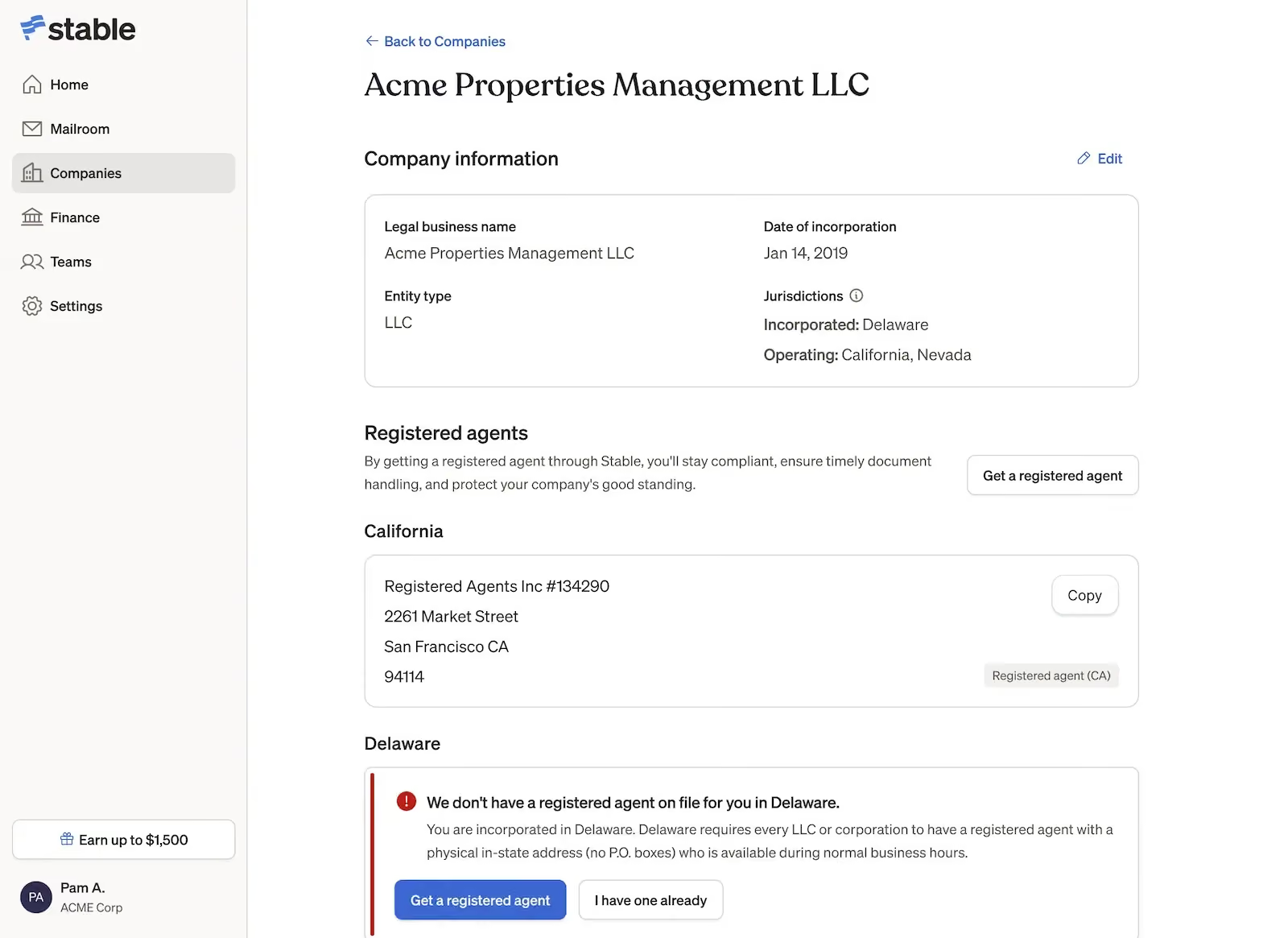
Stable can help here, too. With a few simple company details, Stable shows customers everywhere they have a registered agent on file (and where they may still need one) making it easy to spot gaps as the business evolves. The result is a shift from reactive to proactive. Instead of discovering a registered agent gap through a penalty, businesses can identify and close it before it becomes a problem.
Registered agent compliance rarely feels urgent — until it is. By then, the costs of a missed notice, a default judgment, or an administrative dissolution almost always exceed what it would have taken to stay ahead of the problem. And that's exactly the kind of problem Stable can solve.
Click here to learn more about our registered agent services.