
The right virtual address location can affect your tax bill, your credibility with investors, and how easily you can stay compliant, so choosing strategically matters as much as choosing a provider.
Using a virtual address is a smart way to keep your home or physical office address private and manage mail remotely. However, it’s important to consider how factors like tax treatment vary depending on your virtual address location.
If you’re looking for the best city for a virtual address, we’re here to help. Check out this guide to find some of the best locations for a virtual business address in the US.
Key takeaways
- A virtual address allows you to establish a presence in any state and meet compliance requirements.
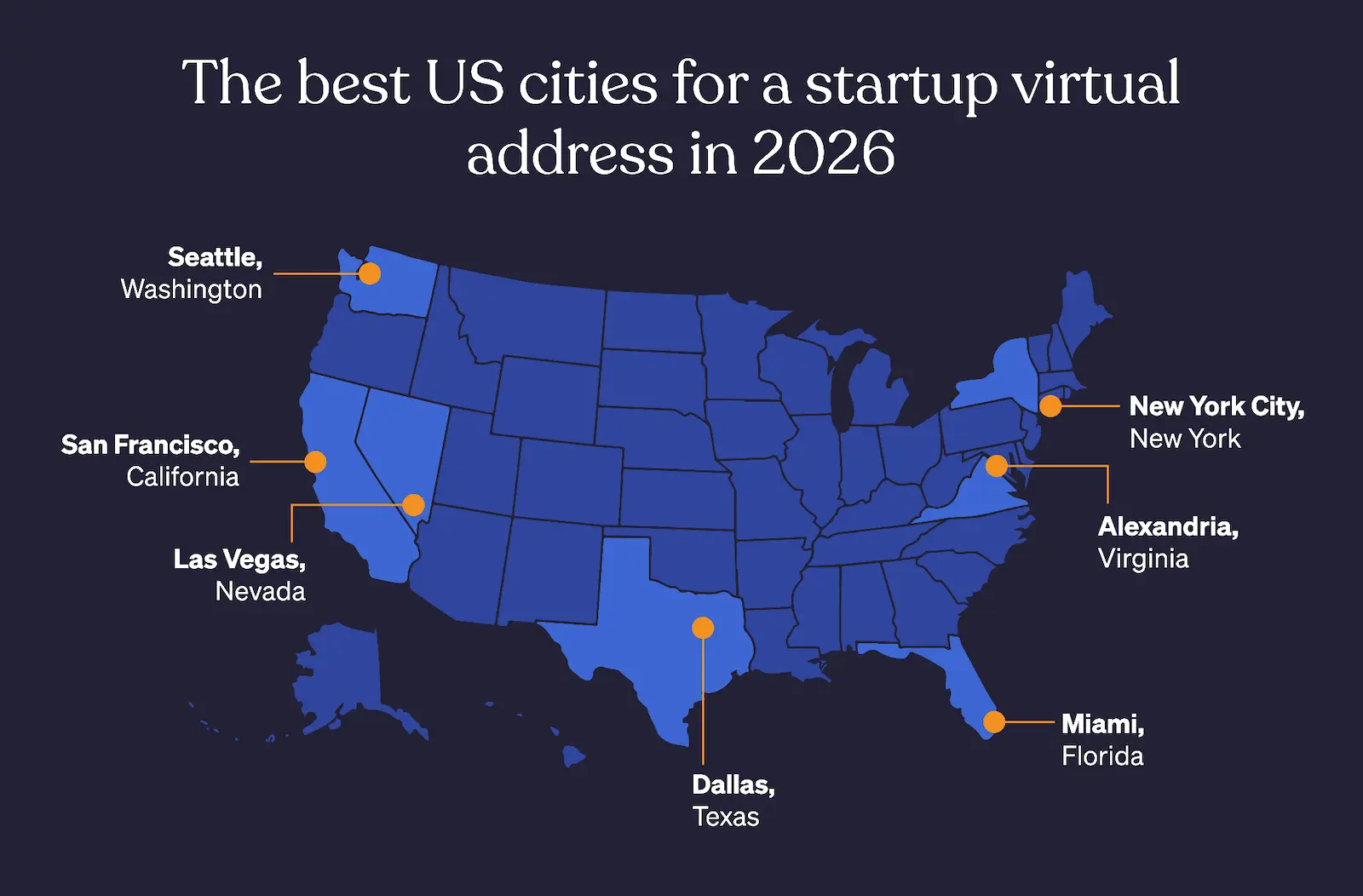
- Popular cities like Dallas, Miami, New York City, San Francisco, and Seattle are some of the best virtual address locations.
- Choosing a virtual address location based on your industry can help you find the right location for your startup.
- Stable offers virtual address and registered agent services so you can easily maintain compliance and simplify mail management.
What is a virtual address for startups?
A virtual address for startups is a real physical address that you can use to register your business, incorporate with the state, and receive mail — all without a physical office. Virtual addresses allow startups to receive and manage mail remotely, enhancing privacy and streamlining mail management.
Why your startup’s virtual address location matters
There are a few reasons why a virtual address can be beneficial for your startup:
- Boost credibility: A virtual address makes your business appear more credible to investors and customers, which makes it easier to secure funding for your business and attract new customers. Having access to funding is vital if you plan on expanding your business over time.
- Ensure compliance: A virtual address can help your business stay in compliance when operating in other states. Your business may need to register and establish a legal presence in states where you operate to meet tax and compliance requirements. A virtual address and registered agent can help you establish a presence in any state, making it easy to expand.
- Privacy: Choosing the right virtual address location also helps protect your privacy. When you incorporate with a home address, it becomes part of the public record in most states. With a virtual address, you don't have to worry about exposing your home or office address or inviting unwanted junk mail.
- Streamline mail management: Using a virtual address even simplifies mail management, ensuring you see important mail items immediately and turning your physical mail into a searchable virtual mailbox.
Factors that make certain cities the best for virtual addresses
If you want to enjoy the benefits of a virtual business address, there are several things you should look for.
- Cost: From state taxes to filing fees, cost is one of the best ways to decide which city is best for a virtual address. Choosing the right city or state can result in substantial savings, especially if you’re not paying income tax.
- Reputation: Reputation goes a long way when you’re choosing a virtual address location for your startup. Major cities like Seattle and San Francisco have a reputation as great cities for startups, and that can make recruiting significantly easier.
- Ecosystem strength: Some cities punch above their weight when it comes to venture capital activity and accelerator density. Registering in a city like San Francisco or New York puts you in the same zip code, at least on paper, as the funds and programs that matter most.
- State filing requirements: Different states have different filing requirements for businesses. If you want to save time and minimize filing costs, choose a state that makes filing simple.
The best US cities for a startup virtual address (2026)
Every startup is unique when it comes to choosing the best city for a virtual address. Compare some of the best cities for a virtual address for startups to find the best fit for your business.
1. Alexandria, Virginia
Alexandria is close to Washington, D.C., which makes it a great option for startups that work with government or enterprise clients. Registering in Virginia comes with a few practical advantages: the state has low startup costs and straightforward annual requirements, and Virginia offers investor incentives — including a Qualified Business Investment Tax Credit — that can be meaningful for early-stage companies seeking funding.
For startups in GovTech, cybersecurity, or policy-adjacent industries, a Virginia address also carries professional weight. The D.C. metro area is home to a dense concentration of federal agencies, contractors, and enterprise clients, and an Alexandria address signals proximity to that ecosystem, even if your team is distributed.
2. Dallas, Texas
Dallas is a popular pick for the best city for a virtual address in large part because the state of Texas has no personal income tax, which can help lower costs for founders and attract top talent.
In addition, Dallas has a rapidly growing startup ecosystem with strong support for tech, finance, and e-commerce companies. The regulatory environment in Dallas is business-friendly, and compliance is straightforward. Plus, the central location makes mail handling and logistics simple nationwide.
3. Miami, Florida
Miami is another city that’s popular largely due to Florida’s lack of personal income tax, which can be appealing for founders and remote teams.
Beyond the tax picture, a Miami address carries real international credibility. The city is a natural gateway to Latin America and a hub for global commerce. For startups with cross-border ambitions, a Miami address signals that orientation to clients and partners. The city is also a remote founder hotspot, which means a Miami address reads as current and entrepreneurial.
Between the tax benefits and global appeal, Miami is a top destination for a virtual address for startups.
4. New York City, New York
It’s no surprise New York City is one of the most prestigious cities for a virtual address, and with a virtual address, you get that credibility without paying Manhattan rent. For remote startups, that's a meaningful tradeoff: the signal value of a NYC address (particularly useful for fundraising, enterprise sales, and partnerships) at a fraction of the cost of actually operating there.
The Big Apple also has one of the most active venture markets, making a New York address invaluable for opening doors when you’re pitching investors or signing enterprise clients. That holds true whether your team is in the same building or scattered across time zones.
In terms of taxes, New York is less favorable than states like Florida or Texas, so if tax benefits are a priority New York may not be the right registration state. But if you’re already registered in another state, or care heavily about investor access and prestige, NYC is a smart choice.
5. San Francisco, California
San Francisco is one of the most popular cities for startups, located right near the famed Silicon Valley. A SF address signals venture credibility in a way few others can…it's shorthand for "we're serious," particularly with tech investors, enterprise buyers, and potential hires who use geography as a first filter. For a distributed team, a virtual address here does a lot of that work without requiring anyone to actually be there.
Similar to New York, California is a less tech-friendly state for early-stage startups. That said, California does offer an R&D tax credit and the California Competes Tax Credit for businesses that want to grow in the state.
For previously established, venture-backed startups, or startups where ecosystem perception matters more than tax benefits, a San Francisco virtual address remains one of the strongest you can have on a pitch deck, at a fraction of the cost.
6. Las Vegas, Nevada
Nevada’s tax benefits are some of the best in the country for startups, and a virtual address lets you take advantage of them without settling in the state. Nevada has no state personal income tax, no corporate income tax, and no franchise tax, which makes Las Vegas a popular choice for new startups.
Nevada also offers stronger-than-average privacy protections for business owners. LLC members aren't required to be listed publicly which is an added layer of privacy on top of the protection a virtual address already provides.
If you’re looking to keep registration costs low and your tax bill lower, a Las Vegas virtual address is near the top of the list.
7. Seattle, Washington
Seattle is one of the top destinations in the country in terms of tech, and is host to a wide range of both successful startups and established industry powerhouses like Amazon and Microsoft. It signals that you're operating in serious company, even if your team is fully remote.
Washington has no personal or corporate income tax, although Washington does have a business and occupation (B&O) tax that may apply.
For a team that wants a prestigious, tech-forward address in one of the country's top startup ecosystems, Seattle is a strong choice.
Best cities by startup type
When you’re looking for the best city for a virtual address, it’s important to consider the startup type. Here are some of the best cities based on the type of startup you’re running:
- SaaS startups: San Francisco, Seattle
- E-commerce: Miami, Las Vegas
- Incorporation: Alexandria
- Low-cost: Las Vegas, Dallas
- Credibility: New York City, San Francisco
What to look for in a virtual address provider
If you want to select the best virtual address provider for your startup, it’s important to look for the right features:
- Virtual address providers should offer a real street address, not a PO box
- Mail scanning and forwarding ensures you see essential mail immediately
- Security and privacy protects your information and sensitive mail items
- Compliance support ensures you’re adhering to state and local regulations
- Providers that offer multi-location flexibility can easily scale with your business
- A virtual address provider who offers registered agent service simplifies compliance
Mistakes to avoid when choosing a virtual address
When you’re looking for a virtual address for startups, there are some simple mistakes you should avoid to make the right choice:
- Don’t choose a provider or location based on cost only
- Don’t ignore state compliance rules
- Don’t mix personal mail with business mail
- Plan ahead to make sure you can easily scale your mail solutions with your business growth
How to get a virtual address for your startup
Getting a virtual address for a startup is a simple process. Here’s how it works:
- Choose the best city for a virtual address based on your business goals
- Select a provider like Stable
- Use your new address to register your business, update your existing registration, or simply start receiving and managing mail
- Start receiving and managing mail digitally, from anywhere
Choose the right virtual address for your startup
Whether you’re in the e-commerce industry or GovTech, choosing the right location for your virtual address is essential. A strategic location, and the right provider, helps you save money and maximize the benefits of a virtual address.
Stable makes it easy to establish a business presence, with premium virtual address locations across the country. We’ve also got you covered if you need a registered agent, with services provided in all fifty states. Contact our sales team to learn more about Stable mail solutions, or create an account to get started with Stable.
Frequently asked questions
Is a virtual address legal for an LLC?
Yes, a virtual address is legal for an LLC as long as it’s a real physical address. Stable provides physical addresses that you can use for your LLC, though additional requirements (such as a registered agent) may apply depending on your state.
Do I need a registered agent in addition to a virtual address?
Yes, LLCs in all 50 states are required to have a registered agent. With Stable, you can add a registered agent in any state where you do business.
Why should I choose Stable when setting up a virtual address for my startup?
Stable is available in high-value cities across the country,, so you can choose a location that works for your business. All your mail is scanned and accessible digitally, so nothing gets missed no matter where your team is. Trusted by 15,000+ businesses and SOC 2 Type II certified, Stable is built to grow with you from formation to scale.