
Claims intake is one of the most document-heavy stages in insurance operations, and one of the most vulnerable to delays. Intelligent document processing (IDP) automates the classification, extraction, and validation of incoming claims documents, helping insurers move faster from submission to resolution without adding headcount.
Claims move only as fast as the intake process allows. Even when claims are submitted digitally, insurers still receive a mix of PDFs, scanned images, forms, photos, and supporting documents that must be reviewed and organized before processing can begin.
When staff must manually sort files, review documents, and enter data into claims systems, intake quickly becomes a bottleneck. These delays push out claim resolution timelines and can lead to frustrated policyholders waiting for updates.
Intelligent document processing (IDP) helps remove this friction by automatically classifying documents and extracting key information at the start of the claims workflow.
This article explores how IDP works, why intake often slows down, and how automation can accelerate the entire claims lifecycle.
Key takeaways
- Intelligent document processing (IDP) helps insurers capture, classify, and process claims documents more quickly.
- Many intake delays begin with manual document sorting, categorization, and data entry.
- IDP automates document classification, data extraction, and validation, reducing manual workload.
- Faster intake allows claims teams to shorten overall claims cycle time and move cases forward sooner.
Modern insurers use IDP to reduce intake backlogs, improve operational efficiency, and enhance customer experience.
What is intelligent document processing (IDP)?
Intelligent document processing (IDP) is a technology that uses artificial intelligence (AI) and optical character recognition (OCR) to automatically identify documents, extract key information, verify its accuracy, and send the data into insurance claims systems.
Instead of relying on manual document review, IDP can understand different document types and capture the specific information needed to begin processing a claim.
Optical character recognition (OCR) is the technology that converts text in scanned documents, images, or PDFs into machine-readable data. In insurance workflows, OCR allows systems to read printed or handwritten text from documents such as claim forms, invoices, or reports so the information can be digitized and used in downstream systems.
How does IDP work in insurance claims?
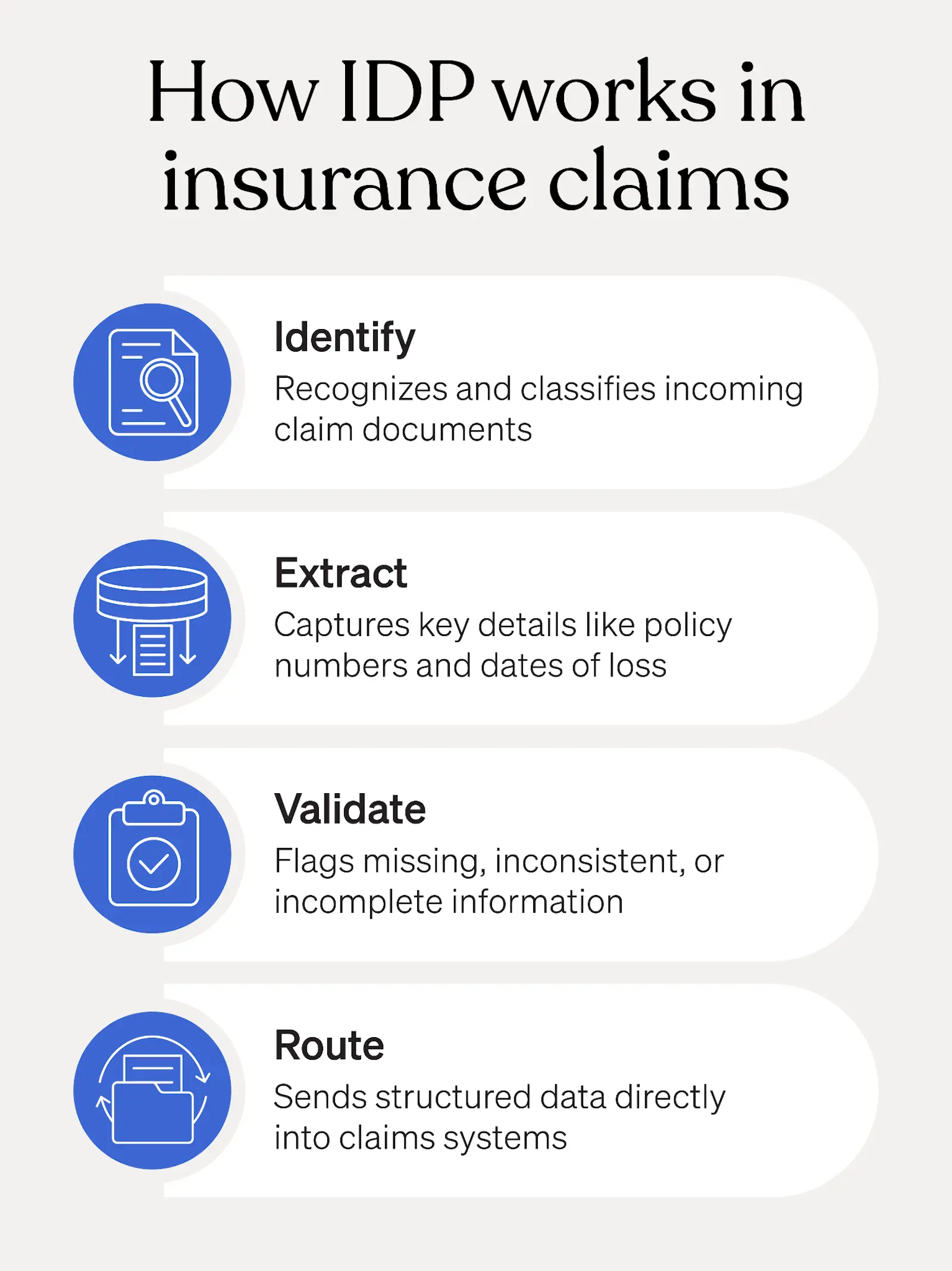
In insurance claims intake, IDP analyzes incoming documents and automatically recognizes what type of document has been submitted, such as a claim form, invoice, or police report.
The system then extracts key information like policy numbers and claimant details while flagging missing or inconsistent fields.
Once captured and validated, the structured data is sent directly into claims management systems. This allows claims teams to start reviewing and processing claims faster without spending time on manual document handling.
How is IDP different from basic OCR?
While OCR simply reads and converts text from documents, IDP goes further by understanding the context and structure of the document.
OCR might capture all the text on a page, but IDP identifies what the document is and extracts the specific fields that matter for claims processing. It can also validate the information against expected formats or system records to catch errors early.
When comparing IDP vs traditional OCR for insurance document automation, IDP significantly reduces the need for manual review and data entry.
Why does claims intake slow down?
Claims intake delays rarely stem from a single issue. Instead, a combination of document complexity, manual processing, and operational bottlenecks can slow the initial stages of the claims workflow.
Document complexity and volume
Claims intake is often slowed by the nature and variety of documentation required to support a claim.
A single claim may include multiple document types such as claim forms, invoices, medical records, photos, and police reports. These materials can arrive in different file formats, including PDFs, scanned images, email attachments, or mobile uploads. Some submissions may also contain handwritten notes or low-quality scans that are harder to process.
Physical mail adds another layer of complexity. First-party claimants, attorneys, medical providers, and body shops frequently submit documentation by mail: forms, estimates, correspondence, and checks that arrive as physical envelopes before they ever enter a digital system.
In many cases, supporting documents arrive at different times, forcing intake teams to continuously monitor and update claim files.
Manual sorting and data entry
Many insurers still rely on staff to manually review incoming documents and categorize them before processing begins.
Intake teams may need to enter policy numbers, claimant information, and claim details into systems by hand. They often cross-check information across multiple documents to confirm accuracy, repeating the same tasks across similar claims every day.
These manual steps slow intake and create opportunities for errors. Understanding how to use automation to clear insurance claim backlogs often starts with reducing these repetitive intake tasks.
Incomplete or inconsistent submissions
Missing or inconsistent information can also delay claims intake. Documents may arrive without key details such as policy numbers, dates of loss, or claimant identification. In some cases, required documents are not submitted with the initial claim, forcing intake teams to request additional information.
When data across documents does not match, staff must pause processing to investigate and resolve discrepancies. Reducing these issues through automation can highlight the impact of automated claims processing on customer satisfaction, since faster intake helps claims move forward without unnecessary delays.
Queue backlogs and surge events
As documents accumulate, intake queues can quickly become congested. Backlogs grow during high-volume periods when claim submissions spike. Catastrophic events such as storms or large-scale accidents can overwhelm intake teams with sudden surges of documentation.
When intake cannot keep up with incoming documents, delays compound and push back the entire claims timeline.
Downstream impact of intake delays
When intake slows down, the rest of the claims process slows with it. Adjusters often need structured, complete information before they can begin reviewing a claim.
Errors or missing data discovered later in the process may require rework and additional verification. These delays ultimately extend the overall claims cycle time and affect how quickly policyholders receive updates or claim resolutions.
How does IDP speed up claims intake?
Intelligent document processing improves intake by removing many of the manual steps that slow claims at the very beginning of the workflow. From document recognition to automated routing, these capabilities allow incoming claims materials to move quickly from submission to system-ready data.
Understanding the key benefits of intelligent document processing for insurance claims handling helps insurers see how automation can streamline intake while reducing operational friction.
Automated document recognition
One of the first ways IDP accelerates intake is by instantly identifying incoming document types. The system can recognize claim forms, invoices, medical records, photos, and other supporting materials without requiring staff to manually sort or label them.
These automations organize files as they arrive and group them within the appropriate claim file. Documents can then be routed to the correct intake workflow immediately. This eliminates the delays that often occur when teams must manually review and categorize large volumes of submissions.
For insurers that still receive significant mail volume, this same logic applies to physical documents: mail that arrives as paper must be scanned and digitized before it can enter any automated workflow, making the physical-to-digital handoff a critical first step.
Intelligent data extraction
Once documents are recognized, IDP automatically extracts the information needed to begin processing a claim. Key details such as policy numbers, dates of loss, and claimant information are captured directly from forms, reports, and attachments.
This eliminates the need for staff to re-enter data into claims systems and helps standardize information across different document formats. As a result, claims move from “received” to “system-ready” much faster. Many of these capabilities are among the best IDP software features for small insurance agencies looking to improve intake efficiency without expanding staffing.
Real-time data validation
IDP also performs validation checks during intake to prevent issues later in the claims process. The system can immediately flag missing fields, incomplete submissions, or required documents that were not included.
It can also identify mismatched policy or claimant details across multiple documents. Duplicate submissions and other inconsistencies can be detected before they reach adjusters. Catching these issues early reduces follow-up requests and prevents intake teams from having to revisit the same claim repeatedly.
Automated workflow routing
After documents are recognized and data is validated, IDP automatically routes the claim to the next step in the workflow. Verified information can be sent directly into core claims systems without additional manual processing. This can trigger downstream actions such as adjuster assignment, claim review, or escalation to specialized teams.
Automated routing reduces the time documents spend sitting in intake queues. As a result, claims reach adjusters and investigators much sooner.
How does faster intake improve claims performance?
When intake moves faster, the benefits extend well beyond the first step of the claims process.
Faster document handling helps teams work more efficiently and improves operational predictability across the organization.
For claims teams
When intake processes run smoothly, claims teams spend far less time correcting errors or chasing missing information.
Adjusters receive structured, validated data earlier in the lifecycle, allowing them to start investigations sooner. This reduces the time spent reviewing incomplete claim files and improves overall productivity.
With fewer intake issues to resolve, workloads also become more consistent and manageable.
For operations
Operational teams benefit from smaller intake backlogs and more predictable processing timelines. With documents automatically classified and processed, claims departments can handle higher volumes without increasing staffing.
Faster intake also improves visibility into claim status and workload distribution. During surge events or catastrophe-related spikes, automation helps insurers respond more effectively without overwhelming intake teams.
How does IDP improve the policyholder experience?
Intake speed directly affects how policyholders experience the claims process. When documents are processed quickly, insurers can acknowledge claims faster and confirm that submissions were received.
Automated validation also reduces the number of follow-up requests for missing documents or incomplete forms. This helps claims move toward investigation and resolution sooner.
Policyholders benefit from clearer communication and fewer delays, which can increase confidence in the insurer’s responsiveness. Over time, a smoother intake process can strengthen trust and improve overall satisfaction with the claims experience.
What should insurers look for in an IDP solution?
Choosing the right IDP tool(s) is important for ensuring claims automation delivers long-term value. Insurers should evaluate solutions based on how well they handle insurance documents, integrate with existing systems, and support secure, scalable operations.
Does it handle insurance documents well?
- Claim forms: The system should reliably recognize and extract data from standard claim forms used across different lines of insurance.
- Medical reports: Medical documentation often contains complex layouts and terminology, so the platform should accurately capture relevant fields.
- Repair estimates: Repair estimates can include line-item costs and structured tables that require specialized data extraction capabilities.
- Police reports: Police reports may vary widely in format and quality, so the system should be able to identify key details despite inconsistent layouts.
- Physical mail: Many insurers still receive a significant share of claims-related correspondence by mail. Look for solutions that can digitize, scan, and extract data from physical documents, including forms, estimates, and legal correspondence. Otherwise mail may become a manual gap in an otherwise automated workflow.
Does it integrate with existing claims systems?
- Real-time data transfer: Extracted information should move directly into claims management systems without requiring manual uploads or file transfers.
- Downstream handoff: Look for solutions that can pass structured, validated data to the systems where work happens — whether that's a claims management platform, an adjuster queue, Salesforce, or a custom internal tool — so documents don't stall after processing.
- Easy system connection: Integration tools and APIs can simplify deployment, especially when addressing the challenges of implementing IDP in legacy insurance systems.
Is it secure and scalable?
- Strong data protection: Claims documents often contain sensitive personal information, so robust security controls are essential.
- Compliance support: The platform should help insurers maintain compliance with industry regulations and data governance standards. For insurers handling protected health information, look for HIPAA-compliant solutions.
- Ability to handle surge volume: A scalable system can process large spikes in claims submissions without slowing intake performance.
FAQs
Can IDP handle handwritten or scanned documents?
Yes. Many IDP systems combine OCR with machine learning models that can interpret handwritten notes and extract text from scanned or low-quality documents.
Does IDP replace claims adjusters?
No. IDP automates document handling and data capture, but adjusters still review claims, investigate details, and make coverage decisions.
How quickly can insurers see improvements in intake speed?
Many insurers begin seeing improvements shortly after implementation, particularly in document classification and data extraction efficiency.
Is intelligent document processing secure?
Yes. Enterprise IDP systems typically include encryption, access controls, and compliance features designed to protect sensitive claims data. For insurance use cases involving protected health information, confirm whether a solution is HIPAA compliant.
Can IDP integrate with existing claims systems?
Most modern IDP platforms are designed to integrate with existing claims and policy systems using APIs and automation tools, making it easier for insurers to get started without replacing core infrastructure.
Faster claims start with faster intake
The speed of claims intake sets the pace for the entire claims lifecycle. When insurers rely on manual document sorting, review, and data entry, even small inefficiencies can create delays that ripple throughout the process.
Intelligent document processing helps remove these bottlenecks by automating document recognition, data extraction, and validation at scale.
Rather than treating intake as a manual administrative step, forward-looking insurers are investing in IDP as foundational infrastructure for modern claims operations. Automation not only accelerates processing today but also provides the scalability and resilience needed to handle future claim volumes and surge events.
Physical mail remains one of the most persistent gaps in insurance intake automation. Even as digital submission channels expand, insurers continue to receive forms, estimates, legal correspondence, and checks by mail. These documents require manual handling before they can enter any downstream system.
Stable helps close that gap. Our AI-powered virtual mailbox automatically scans and digitizes incoming mail, and our Data Extraction feature pulls structured field data — policy numbers, claimant names, invoice amounts, due dates — directly from documents, making it available in your dashboard or pushable to tools via webhook or API.
It's not a replacement for a full IDP platform, but for the portion of your intake that still arrives by mail, Stable removes the manual step between envelope and system. Contact our sales team to learn how Stable fits into your claims document workflow.