
Business mail may seem routine, but the data shows it has a measurable impact on how teams spend time, where work gets interrupted, and how operational risk shows up across an organization.
Business mail is a task that’s easy to forget about. It’s something organizations deal with every day, and rarely feels like a priority — until something goes wrong.
But when we analyzed how organizations actually manage mail, a different pattern emerged. Yes, mail is a day-to-day administrative task. But it’s also a workflow that cuts across operations, finance, customer experience, and leadership, often in ways that are not immediately visible.
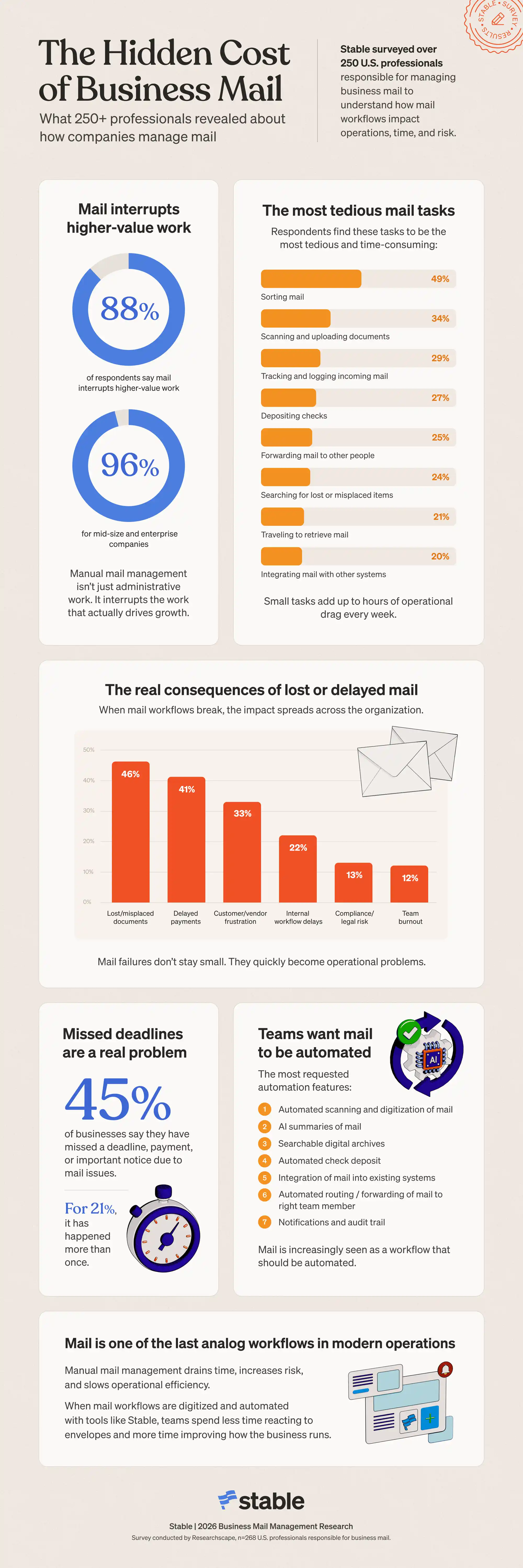
We surveyed more than 250 US-based professionals responsible for managing business mail to understand how these mail-driven workflows function. The infographic below highlights the most important findings, offering a clear view into how mail impacts time, attention, and outcomes across modern businesses.
Business mail data shows how often work gets interrupted
The data shows that mail consistently interrupts higher-value work that contributes to business success and continuity. A large majority of those surveyed reporting mail management tasks — like reviewing mail, routing items to the right individuals, and following up on missing mail — steals time from more important work.
The pattern becomes more pronounced in bigger organizations, where mail volume is higher and coordination happens across multiple teams or locations. This matters because business performance is directly tied to focus.
When attention is repeatedly redirected toward reactive tasks, it becomes harder to sustain progress on work that improves the business. Over time, this leads to slower execution and delayed initiatives.
Mail management statistics reveal the cumulative cost of small tasks
Another clear insight found in the research is how much routine, mail-related tasks absorb valuable time.
Those responsible for managing mail are routinely opening mail, scanning it, tracking it, and forwarding it to the right team. These tasks are not complicated, but they happen every day.
Instead of being automated, these menial tasks happen throughout the day, between meetings and overlapping with other responsibilities.
This creates a steady cadence of interruptions instead of a predictable workflow.
And that’s how operational inefficiency creeps in. There may not be a single failure, but businesses experience a pattern of repeated effort that makes it harder for teams to focus on higher-impact work.
The operational impact of mail extends beyond the mailroom
When mail workflows function smoothly, they tend to go unnoticed. But when they break, the effects spread quickly. The infographic highlights common outcomes, including lost documents, delayed payments, internal workflow delays, and customer or vendor frustration.
These issues rarely stay contained. A delayed document can slow financial processes, a misplaced item can require coordination across teams, a missed delivery can create downstream confusion.
This is what makes mail management more than just low-value, manual work.
Ensuring mail moves reliably through your organization could mean the difference between a healthy business, and one with operational inefficiency.
Business mail trends highlight timing as a key risk factor
One of the most telling insights in the data is how often mail-related issues lead to missed deadlines. A meaningful portion of respondents reported that they have missed a deadline, payment, or important notice due to issues with mail. For some, this has happened more than once.
When it comes to mail, timing is of the utmost importance.
Mail often contains important information that kicks off additional work. But it’s not only about accessing that information. It’s about accessing at the right moment. When mail is delayed or lost, the impact can be overwhelming: important decisions are delayed, and time-sensitive work is postponed.
In some cases, the consequences can be felt beyond internal operations. This is where mail transforms from an operational inconvenience to a source of business risk.
Teams are prioritizing automation and visibility in mail workflows
As with many other work functions, the way businesses manage mail continues to evolve.
Survey respondents note that they want technology solutions to decrease manual effort, and increase visibility. That means automated digitization and routing of mail, integrations with the systems they use every day, and searchable records of physical documents.
These results reflect a broader shift in expectations when it comes to mail management. Businesses increasingly expect workflows to be automated, intuitive, and reliable. They want processes that don’t require repeated manual intervention and that allow information to move through the business quickly.
AI-powered mail management is part of that shift.
What this infographic reveals about modern mail workflows
A clear pattern emerges from Stable’s latest research data.
Physical mail management is one of the few processes that still depends heavily on physical handling and manual coordination. Because of that, it behaves differently from other systems inside the business.
That difference is where inefficiency shows up, and it is precisely where opportunity exists.
When repetitive workflows are structured more effectively, teams regain time and attention. That capacity can then be redirected toward improving processes, supporting customers, and moving the business forward.
This is not about eliminating mail. It is about ensuring that it supports modern operations, instead of slowing them down.
Read the full research report on the hidden cost of mail management here.